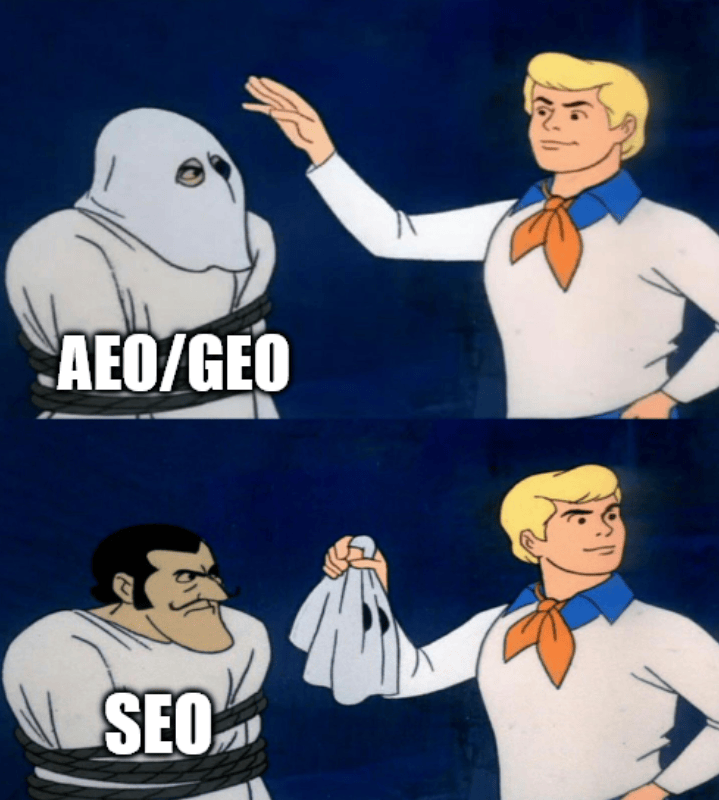
Your AEO/GEO strategy has the same level of accuracy as a horoscope (sorry guys!)
Both AEO (Answer Engine Optimization) and GEO (Generative Engine Optimisation) focus on influencing how LLMs (large language models) incorporate your brand's content into AI-generated responses. But it's worth noting LLMs are not search engines; they don't build search indexes like Google, Bing, Startpage, Kagi, etc., or crawl the web themselves. So when someone does an AI search on ChatGPT, Perplexity, Claude [insert your AI of choice], the LLM sends a query to Google known as grounding queries, or more commonly known as the QFO (Query Fan Out), and Google returns results.
So what does this mean? For AI search, you want to optimise for the QFO, not the prompt! And Google also confirmed this theory its June 19th conference in Milan: AI Overviews do not replace the classic search index, but rely on it.
Here is a screenshot below of a search example I performed in Perplexity with a QFO:
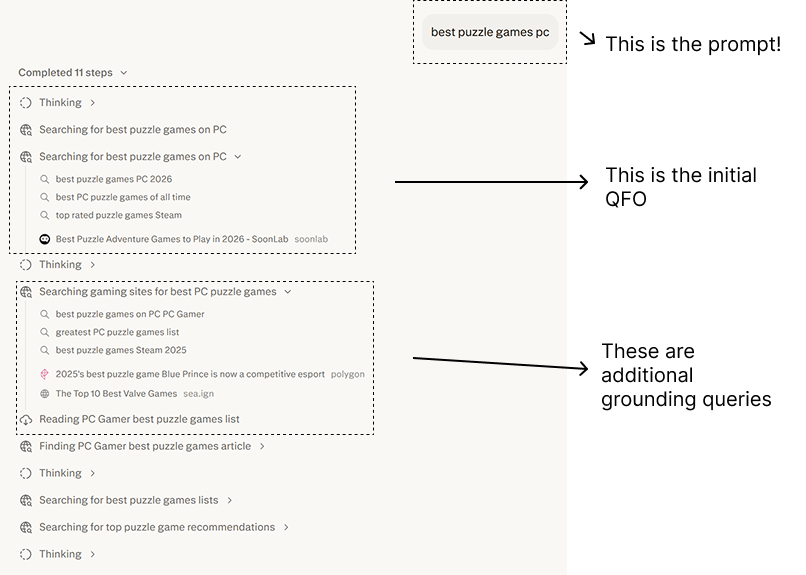
AI search is dynamic.
Back in the old SEO days, you could stuff your content by targeting specific keywords like 'X game is the best puzzle game for PC!' and Google would return the result. After several Google updates like March 2026 Spam Update, content stuffing is dead – it's considered low quality content. Instead, AI prioritises the same foundational SEO pillars:
- High quality content – how thoroughly a question is answered. Research and data are great for this!
- E-E-A-T (Experience, Expertise, Authority, Trustworthiness) – the traditional SEO playbook. AI-generated, low quality content that doesn't offer the user anything new will not be recommended in the search.
- Clear content structure – believe it or not... AI needs your website to be accessible just like a regular user. If it can't understand what's reading or looking at, then it won't be recommended.
- Content freshness – how up-to-date and relevant your content is! There's still an incredible amount of value in going back to old articles from a year or two ago and updating it with the current year and any new information.
The SEO fundamentals still matter. Studies show 38-58% of AI citations come from the top 10 Google search results. Strong SEO drives AI visibility, not the other way around. It is still the foundation of AI search.
So if it's still SEO, is AI useless?
Not really. There's a few overlapping data points worth paying attention to. Seer Interactive's September 2025 research reveals that brands cited by AI get 35% more clicks. And the data backs it up: AI is getting adopted globally whether you're pro-AI or anti-AI.
But what has changed for SEO is that AI places higher value on citation-friendly formats like listicles and articles, longer queries (AI queries average ~30 words vs the old ~4 in traditional search), and multi-platform presence – which helps the brand build authority.
AI is just an extension of SEO. SEO is not 'dead' as many would claim, nor are GEO/AEO separate. You're not just checking if the best puzzle game for PC is surfacing on Google, but on a LLM too.
'OK, thanks Tess! Off I go to Reddit–'
Wait! Wait, I shriek!
Why isolated mentions don't work
Yes, maybe you read that AI cites Reddit the most, but posting 'X is the best puzzle game I've played on the PC!' on r/gaming is not enough on it's own. SEO is compounding. It benefits from a QFO approach (or a hub-and-spoke model if that makes more sense to you.)
If you say one thing in one place, can you back it up it another place?
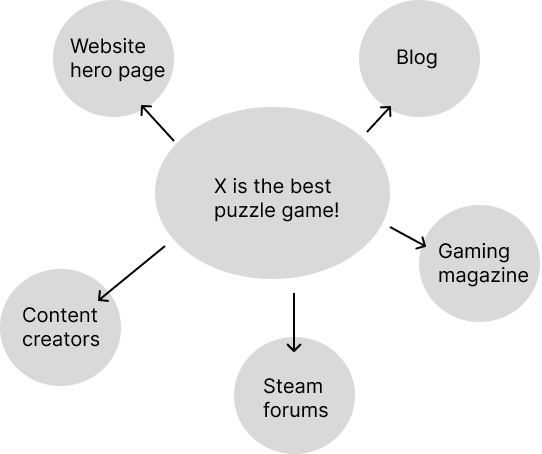
Everything needs to be connected and provable (which is exactly how AI's QFO works!) A single reply to someone's post on Reddit asking for puzzle game recommendations isn't going to be cited in AI because it's just that – and isolated instance with nothing else pointing to it. But if that same reply is echoed and reinforced across your website, your socials, your blog, your studio partnerships, etc., it stops being isolated. It becomes a hub-and-spoke network that AI can actually trace and trust. AI citation rewards SEO fundamentals.
Reddit is also one of the most cited AI citations because Google pays Reddit $60 million per year to make its content available for Google's AI search engine training. The reason Reddit ranks so well in AI searches is because it's moderated by humans. Reddit is really hard to spam! Reddit moderators will ban and block you in order to keep their communities relevant! It basically comes with built-in content authority.
My recommendation: stop chasing the AEO/GEO trend. It's not an isolated thing replacing SEO, it builds on it. If you're doing SEO fundamentals and backing up your claims across channels instead of scattered, isolated mentions, then you're already doing AI search optimisation.