I consider myself a history nerd. I've lost countless evenings to Wikipedia rabbit holes reading about everything from the people of Rotmistrivka to how Oxford University's dreaming spires were built to the definition of gnosticism because one thing led to another (as it so often does late at night). So when I discovered Anthropeum, a daily quiz game where you guess when and where historical artefacts are from, I thought I'd be pretty good at it.
Anthropeum is a free browser game created by Matthew, a self-professed coin collector and history buff, that pulls public-domain images from The Met's collection. Each day you're shown ten artefacts and asked to guess when and where each one came from. The game is possible thanks to The Met's Open Access Initiative, which made nearly 500,000 public domain works freely available online for anyone to study! So Matthew took half a million artefacts and turned them into a daily history puzzle.
I went in delusional about how well I'd do, and got humbled: I got all ten artefacts wrong. Sure, I occasionally guessed the right country or landed vaguely in the right century, but I was bad at getting the whole thing right. And yet, instead of feeling embarrassed, I found myself alarmed at how much I didn't know.
We love to repeat the phrase, 'Those who don't know history are doomed to repeat it,' especially now, as history, education, and culture keep getting pushed further from public knowledge and public funding in the U.S..
The very first artefact I got wrong was a golden statue from Tibet dating back to the early fourteenth century CE. Based on its posture, I guessed India and picked a random time period.
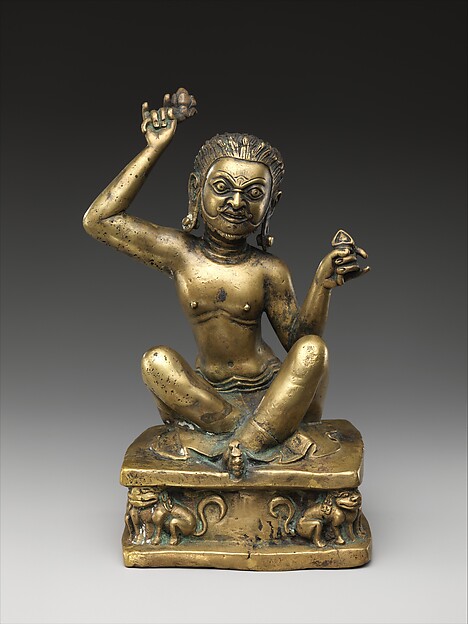
Yeah, I was wrong. But Anthropeum showed me a short museum description:
A wide-eyed mahasiddha plays cymbals and sings ecstatically. Such yogis belong to an Indian tradition of eccentric practitioners of Tantrism, much revered in Tibetan Vajrayana Buddhism. Mahasiddhas were instrumental in introducing the meditation system perfected by the Dzogchen masters of the Nyingma order, founded by Padmasambhava in the eighth century.
That tiny paragraph completely derailed my evening.
Within minutes, I was learning about what a mahasiddha is, what Tantrism and Vajrayana Buddhism are, who the Dzogchen masters and the Nyingma order were, and who Padmasambhava was. Off I went down another Wikipedia rabbit hole.
That's what Anthropeum manages to pull off. It doesn't punish you for being wrong – there are no in-game penalties – but rewards you for becoming curious. Every incorrect guess is an invitation to learn something new.
That being said, the more I played, the more another thought kept nagging at me: most of these artefacts come from Africa, Asia, South America, Greece, and countless other cultures whose histories now sit in Western museums. Anthropeum acknowledges this directly on the home page of its website, saying that many of these relics were taken through colonialism, conquest, or looting, and have never been repatriated to their countries of origin.
The Met, like many Western museums, including the Louvre and the British Museum, hold an untold number culturally significant objects whose ownership remains contested. Anthropeum doesn't ignore the reality of how an artefact like the golden Mahasiddha ended up behind museum glass thousands of miles away from Tibet.
Anthropeum is essentially a history-flavoured Wordle, but also asks players to think about repatriation in a way few games do.
I still play it when I can, not to improve my score or to finally get all ten artefacts right, but because it's ten minutes of intentional curiosity.